

The rapid rise of AI-assisted writing tools has transformed how academics approach research, drafting, and revision. Among these tools, Jenni.ai and Write.studio represent two distinct paradigms: one focused on AI-driven writing acceleration, and the other on structured academic workflows with integrated support.
This blog compares their features, strengths, and limitations to help you determine which tool aligns with your academic writing needs.
Jenni.ai: AI-Driven Writing Acceleration
OverviewJenni.ai is an AI-powered writing assistant designed to help users generate, refine, and cite academic content in real time. It operates as a co-writing system, offering autocomplete and context-aware suggestions as you write.
Key Features
- AI autocomplete that generates sentences and paragraphs in real time (Jenni)
- In-text citation generation across thousands of styles (Jenni)
- PDF-based research integration (upload papers and generate from them) (Jenni)
- AI chat assistant for summarising and querying research (Jenni)
- Outline builder for structuring papers (Jenni)
- Integration with tools like Zotero and Mendeley (Jenni)
Pros
- Strong drafting support: Real-time autocomplete reduces writer’s block and speeds up writing.
- Research-aware AI: Can generate content grounded in uploaded sources.
- Citation automation: Handles referencing efficiently across formats.
- Fluid writing experience: Works alongside the writer rather than replacing them.
Cons
- AI reliance: Risk of over-dependence on automated writing assistance.
- Variable depth of output: AI-generated text may lack critical analysis or originality.
- Citation reliability concerns: Requires manual verification despite automation.
- Tone inconsistency: AI suggestions may drift toward generic academic language.
- Limited structural guidance: Focuses more on writing than on overall document architecture.
- Primarily supports journal articles.
- Limited to academic library; lacks support for grey literature.
- Limited control over formatting; embedded in document making it harder to swap target journals.
- Support for collaboration is lacking.
- No inline table of contents.
Write.studio: Structured Academic Writing Environment
OverviewWrite.studio is designed as a complete academic writing system, combining structured templates, AI assistance, and collaboration tools. It prioritises workflow, clarity, and academic rigour over raw text generation.
Key Features
- Structured templates for essays, theses, and journal articles
- Section-based writing aligned with academic conventions (e.g., IMRaD) or custom
- Integrated citation management (author-date, footnotes, endnotes, multiple, customisable)
- AI assistance for outlining, editing, and summarising
- Real-time collaboration and feedback tools
- Export to Word (fully editable), and PDF
- Extensive reference library with import from more than 20 tools
Pros
- Strong academic scaffolding: Guides users through the logic and structure of research writing.
- User-friendly interface: Easier for non-technical users than many AI tools.
- Integrated workflow: Combines drafting, referencing, and collaboration in one environment.
- Better for sustained projects: Particularly useful for theses and long-form writing.
- Flexibility for control of formatting making it easier to swap target journals.
- Supports a terminology writing for reuse of text and prompts.
- Automates formatting and quick to change target journal.
Cons
- Less powerful AI generation: Not as strong as Jenni for rapid drafting but has excellent editing capabilities.
- Less established with fewer users.
- Library integration could be improved.
Head-to-Head Comparison
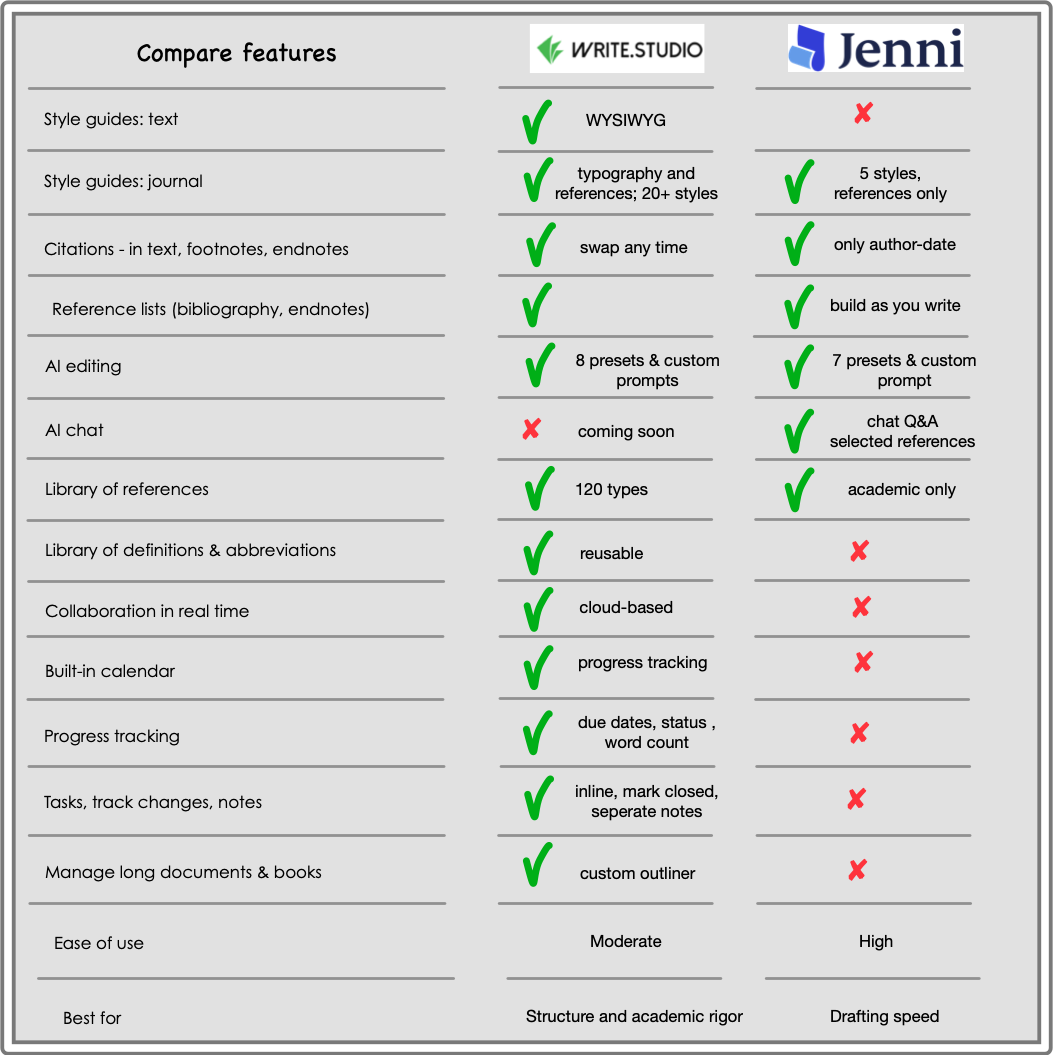
Which Tool Should You Choose?
- Choose Jenni.ai if…You want to write faster, overcome writer’s block, and generate drafts quickly. It is particularly effective for early-stage drafting and literature review support.
- Choose Write.studio if…You need structure, guidance, and collaboration, especially for long documents (e.g., theses, dissertations), formal academic publications, or grey literature (e.g., reports).
Final Thoughts
Jenni.ai and Write.studio reflect two different philosophies of academic writing technology. Jenni.ai excels at augmenting the act of writing itself, while Write.studio focuses on supporting the broader research and writing process.
For many academics, the optimal workflow may even involve using both tools together—Jenni.ai for drafting and Write.studio for structuring and refining—highlighting the increasingly hybrid nature of AI-supported scholarship.